Banner

Showing posts with label school. Show all posts

Sunday, 2 May 2021

When life gets busy...

 It turns out, that I'm not such a writer after all.

While my dream remains to be a published author and write for a living, it turns out that when life gets busy and time is short, the two things on my "to do" list that I drop first are exercise and writing.  

As a result, I've still not got a book or online course finished to a good enough standard for publication, and I'm still a larger dress-size than I'd like.

My top priority is my family:  

Mr Build-it is motoring through Year 7.  He's still got plenty of time for cuddles with his mum, but kisses are already off limits.  He spends a lot of time in his room learning how to programme and is developing and building websites and online games and learning different programming languages.  I try to keep up, and always show an interest, but quite often he is speaking a completely different language.  He appears downstairs whenever he is hungry.  My main task with him is encouraging him to get some daylight and fresh air on a daily basis, though that's got easier as he's discovered that some of his schoolfriends like to meet up at the playpark up the road so he takes himself up there to meet them.


Miss Busy is at that very delicate age where she has subconsciously realised that she's growing up fast, but is not yet ready, and is clinging to childhood.  This means that she's watching terrible kids' TV, and is requiring a lot of parental attention.  I'm also aware that in a very short time she won't be wanting to spend so much time with me - her friends will become more of a priority.  So when she asks me to do something with her, I'm tending to say "yes."  We had a lovely time drawing butterflies together the other day, and, dare I say it, we had fun tidying her bedroom together yesterday.  She's also super-helpful at the moment, and always willing to lend a hand in the kitchen, take the dog out for a walk or hang the laundry - long may it last!

Husband is, as always, very busy with work.  He's also got a lot to do with our Scout Group.  He became Group Scout Leader a year ago and, never one to do a half-job, is determined to have our Group be the best in the District - an example of "how it works".  He's putting in a lot of hours and it's really beginning to show fruit.  Our Group is a happy place to be.

I've recently gone back to the classroom once more.  I'm teaching a lovely Year 5 class who need a great deal of teacher love.  I'm determined to do a good job for these children, so I'm pouring in the effort and the hours of preparation that they deserve.

In the meantime, with Covid19 (fingers crossed) finally receding in threat, we are back face-to-face with our Beavers and Cubs.  After a long break it's taking us a little while to get back in the flow, and I'm also bringing in a lot of new children, and trying hard to get a few more volunteers into the mix.  My County role has had to take a bit of a back seat while this is happening, but I am also still delivering regular adult training courses and attending meetings.

So... with family, school and Scouting all taking a lot of time and energy, and the continuous cycle of groceries, shopping, laundry, school run and dog walks... that hasn't really left a lot of time for writing or crafting (or exercise).  So that's where I am right now.  I'll come back to you next time with an update on how I'm getting along with those craft plans and New Year resolutions.  


Wednesday, 23 December 2020

The Playful Way - and other stories...

 I'm delighted to report that life "Chez Mel" is pretty good just now.

Out of school...

Earlier this year, during lock-down, I took the plunge and handed in my notice from my teaching job. 

It's something I've been thinking about for quite some time. It isn't that I don't like teaching. I do. I love working with children. To me, teaching children is all about finding that spark, getting them excited about learning and developing their confidence to take on the challenges and discover the world. 

It wasn't that I had a problem with the school either. The school I taught at was rated OfSted Outstanding and is a great school. The staff are caring and incredibly hard-working and do everything they can to make the school a great place to be. 

No, my problem is with the system itself. I think that OfSted and the Government are getting it wrong. The problem is that they are pushing for more and more "measurable" results, but this means that teachers and schools are focusing on teaching the things that are measured. 

The potential is that you can end up with children being taught methods but without necessarily any understanding, and deja vu classrooms:

  • if you go into one classroom at 9.15 in the morning, the lesson in the classroom 2 doors along will be structured exactly the same way.  
  • The display boards will all have the same information on them. 
  • The doors will all have the same poster on them. 
  • The maths equipment will all be laid out the same way.
In addition, children that fall behind this rigid routine are taken out for support, but this is almost always during the non-core part of the curriculum - depriving them of the opportunities where they might be able to shine - art, music or computing. 

While I agree that structure and routine are beneficial to many children, and that sharing good practice makes sense, I would argue that this takes the joy and excitement out of school and learning.  

Where is the space for that eccentric teacher so in love with their subject that the children will remember for the rest of their lives? 

Where is the space for spending longer on something that the children have got excited about, or that they need to work on a bit more to cement understanding? 

The flexibility and pleasure is being sucked out of our schools by the insistence that they all achieve more results and tick certain boxes. 

Of course we should weed out poor teachers so that all children have the chance to attain well. 

Of course we should look for quality in our classrooms. 

However, that quality can take many shapes and teachers and children do not come in a one-size-fits-all uniformity. 

While everybody needs to be taught to read and write, they may all learn best in different ways and at different pace, I don't think this is recognised by our education system.

So, off my soap-box... What am I doing now?

...and into writing

I think I've always been a writer. Writing is one of my creative outlets, but I've also found that since I'm able to coherently arrange words on the page, I am often called on to write newsletters, web-content, draft emails and so on. 

I have made some income from writing before, taking on several freelance projects when I was a stay-at-home-mum.

I decided it was time to turn my attention to this once more.

I started off by setting up a new blog - www.the-playful-way.com. The idea was that I could write about something I really believe in - "my niche" - and use it as a spring-board to write a series of books, online courses and articles, as well as being a brand for relaunching my Etsy shop, which I renamed "The Playful Way" and for a tutoring business.

However, I had a bit of a panic about no steady income. I'd assured Husband that within a few months I would be able to bring in as much money freelance as I was as a part-time teacher.

I suddenly didn't see that happening, so jumped at the opportunity for some regular web-content writing for a marketing guy. I was soon writing articles about electric guitars, comparing ecommerce, shipping and project-management platforms, writing about "Best peanut butters for dogs" and different Japanese dog breeds. 

You name it, I was writing about it. The pay was peanuts, there was no by-line, and with all the research and weblinks required, it was taking several hours to write each one. I realised that I'd sacrificed my actual passion and the potential to make real money, for the security of creating click-through content for steady pay.

After three months, I wrote my last piece for this stream of income last Monday.

I'm looking forward to completing my first e-book and course "Making Maths Fun - a guide for parents and teachers" by the end of January. Also back to the blog, and focusing on some other writing projects. This bit is about believing in myself. I know I can do this - I have to hold out for projects that I believe in, or that pay what I'm worth.

...and back into the classroom!

In the meantime, I was also approached by a friend and former colleague. She'd heard that I was doing a bit of tutoring, and wondered if I might be interested in helping out with Phonics Catch-up at the school where she is deputy-head. I'm there to help the children who, due to the covid lock-down last school-year, missed out on learning opportunities, reading material and, for some, even exposure to English. 

I spend two hours each day working with small groups in Key Stage One to support and teach phonics and help them with their reading.

It's a short-term post. I'm hoping to have made enough of an impact by Easter that they will have caught up and be able to read confidently. In the meantime, I feel inspired that I'm able to use my teaching skills to make a real difference to children who really need it.

I've also had a few enquiries about tutoring. However, because I currently run Beavers and Cubs from 4.30pm two evenings each week, and my children have piano lessons on a third evening, as well as all my other Scouting commitments, I have only managed to squeeze one tutoring client in! We're working on her confidence with Maths. 

And in other news...

This post has been a lot about my work life. I think I'll leave it there and post on another occasion about what else is going on... as a mum and wife, with the house, with the pooch and as a volunteer.

Saturday, 4 April 2020

Why it's okay NOT to do Joe Wicks

No offence meant to Joe Wicks here.  I've done a couple of his workouts and the man is a legend.  The internet is bursting at the seams with activities that you can plug into or do at home at the moment.  There is so much choice out there.  The issue is that so many of us are trying to work from home and educate from home as well as just existing.  All these activities are a good source of inspiration for parents who are used to out-sourcing their children - gym classes, Cubs, swimming lessons, boxing and so on.  However, it does leave you with a vague sense that if you aren't doing Joe Wicks every morning, followed by online art lessons, online Steve Backshall, online Scout activities and online education, as well as downloading all the free resources being offered by the BBC, Twinkl and every other portal on the interweb, then you are somehow failing your children.

I'm here to tell you that this is not so.  

What is important is maintaining sanity and love within your family.  

In a time full of financial and health anxiety, in a time when people are concerned about their jobs and their family and friends, in a time when we are facing an unprecedented global pandemic, that's when we are all confined to our homes and cut off from friends and from the outdoors.  A walk alone in the woods is my choice of activity to re-balance and to restore my sense of self and optimism.  We normally have a healthy mix of society and solitude in our lives.  Time to think and time to talk.  At the moment we have some people forced into solitude, while others are denied it.  It's hard for our children too: used to the routine and society of school, time and space to run and jump, laugh hysterically at the daftest things, feel proud of themselves when they get the right answer or seek solace with friends if they don't.  Now they're stuck at home with only a limited understanding of why. 

I'll be honest.  I'm finding this hard.  I'm supposed to be self-isolated for another ten weeks.  I want to do a good job for the families I'm supporting as a teacher and as a Scout volunteer; I want to get the house and garden looking good; I want to build up my writing again; I want to get fit... all during this period of isolation.  What I'm learning though, is that looking after myself and my family is going to have to take priority here.  In the last few days I've had a deep sense of anxiety, unease and disquiet.  I have been irritable and tearful.  Miss Busy, who is very nine: noisy, messy and emotional, is finding the lock-down overwhelming and needing her mummy.  My husband, when he gets home from a busy and tense day as a hospital doctor, needs a lot of support too - for him, planning for the future helps him deal with the present.  

So I'm remembering that I need to prioritise cuddling with a film over replying to e-mails;  Playing a board game with the children over cleaning the floor;  While my to-do list doesn't get any shorter, reaffirming connections within the family, building our strength in this time of uncertainty, seems the more important task.  When this is over, like the flowers that grow back more vigorously after they've been cut back, we will be ready to bloom vibrantly.  When we look back, we'll think of 2020 as the year that made us.

So don't feel that you have to be busy all the time.  Don't feel that you need to keep up with all the activities and resources.  Don't worry about fancy-schmancy specially-created internet resources and lessons.

Do your best to keep up with the things that you have to do for your work and your children's education (don't worry too much about this - they are remarkable at learning when nobody is teaching them, and will also soon fill in the gaps when they get back to school).  Mostly though, it's okay to do the simple things, to spend time just being, and just connecting with your children.

Here are a few things you can do as a family: 

1) play with the kids - get the Lego or the doll house out and get down there and play with the children.
2) Do the housework together.  This one may be a harder sell for older kids, but I taught Mr Build-it to iron shirts yesterday (we had to submit a video for his Scout Skills Challenge), you're teaching them valuable life skills, and its definitely more fun when you do it together - and that's a life-lesson in itself.
3) Play silly games like charades and hide-and-seek.  A daft friend posted a video of herself playing noughts-and-crosses with her dog.  (ask and I'll tell you how - very amusing!)
5) Rediscover peaceful crafts that you can just sit and do together - drawing, painting, rock painting, crochet, knitting and sewing.  Or if those don't appeal - how about wood-work or creating miniature models for Warhammer or a model railway.  These things take time and lets face it, we're not going anywhere in a hurry, and you get the satisfaction of creating something.
6) Bake and cook together.  Explore those cook books and come up with some recipes that you can make.  (Forward planning is useful here as given the shopping limitations for most of us at the moment.)

Most of all, try to relax.  Don't try to do too much.  Press the "Reset System" button on your life.

Thursday, 26 March 2020

Thoughts on Home working and what we're all doing in the shut-down.

I posted yesterday about Home Learning and how to support the children during this shut-down.

In the meantime, what have I been doing?  As a teacher I am technically a key worker but my underlying kidney disease, vasculitis and immune suppression mean that I am classed as "extremely vulnerable".  I have been home-working since last Wednesday, and as of Monday evening am on the list of people who are not supposed to leave the house for 12 weeks.  

 Each morning I have started with my home-working teaching tasks while the children have been busy with their work.  This involves working with my Year 2 colleagues to compile appropriate work for the children to do from home in each of the subject areas.  As parents email the work in, we note it, respond, post something on the school twitter-feed, post the answers for the parents to be able to mark their work and generally follow up.  We're also taking the opportunity to catch up on paperwork and planning across the school.

After I've done this, I move on to virtual Scouting.  I'm running a Cub Pack and a Beaver Colony so I'm regularly posting activities or badge work that children can be getting on with at home.  I'm looking forward to running a virtual meeting on a video-call platform too so they all get to see one another.  We'll probably have a go at that next week.  

In my County Scout role I'm rearranging adult training modules so that people can pick up on them after the shut-down, but also supporting people to use this opportunity while they are at home to do some e-learning and get their training validated.

Once I've done this I move on to writing.  I'm trying to warm-up my skills a bit by entering writing competitions.  I know that I'm unlikely to win any prizes but the discipline of a deadline and trying out writing in different genres is quite refreshing.  I've entered a Travel Writing one so far, and am now working on an entry for a humorous poetry competition.  Also the fact that I'm stuck indoors, I can stretch my wings a bit here on my blog.

Each day I'm also making sure that I get some exercise.  I've returned to my old favourite Claire Sweeney Slimming World DVD but also had a go at Joe Wicks does PE this morning with the children.  I'm attempting to tame a mature and somewhat wild garden, starting with a patch that Miss Busy has asked to adopt.  Also, the house hasn't been so clean since just after we moved in.  We do have some decorating to do but, while the sun is shining, the garden gets priority.
Plus, of course, spending time with my children.  Making sure that they are getting some of their schoolwork done and not spending all day in front of a screen.  Making sure that they are okay.

What are you all doing during this shut-down?  What does your day look like?

Wednesday, 25 March 2020

Thoughts on "Home-learning"

Schools are closed and many of us are cooped up in our homes with our children.
Miss Busy doing yoga as set by her teacher
That's no bad thing.  We all lead over-busy lives, racing around from activity to activity.  While nobody wants this Coronavirus and we all wish it would go away, while nobody wants to be forced to stay indoors and not be able to work (and for many people - earn money), this time of enforced confinement may be the reset button they were looking for in their lives.  It's certainly a time for us to re-establish a connection with our children.  

Most of us leave the children's education to school.  We occasionally glance at or support homework, and we turn up at parents' evening, but we aren't really involved with their learning - that's school's job, right?  Now we are being asked to support and guide our children through all their learning tasks for a protracted amount of time.  Many schools are trying to support the parents and continue managing the task of educating by providing work each day and asking the children/parents to submit it.  As parents, how do we manage this?

First, I think it's important to remember that you are the parent and you know your child.  You have a few options here:
1) stick to the school timetable, or create your own strict timetable.  Use the school's materials or some you have provided or sourced yourselves.  You can either work with your child, ensure your child understands the task and supervise them, or rely on your child to stick to the timetable.
2) use the materials the school has provided, or materials of your own, but throw the timetable out of  the window.  Opting instead for a "as long as you get everything on the list done, you choose how long to work on it and when to do it" attitude.  This works well with children who are largely independent, but you can also encourage children to come to you for specific tasks or if they need help.
Miss Busy helped me out by trialling an activity I set for my Year 2 class.
3)  Ignore any "formal" learning materials.  Take this time to connect with your child, trust that they will fall into a natural rhythm and that they will be learning through living.  Encourage creative activities, but don't be too hung up on curriculum or formal lessons.  If you are following this option, you should let your school know your intentions.  During this time of shut-down there is nothing to stop you doing things your own way, but teachers, who are working hard to provide and follow up on set work will be concerned about you and your children if they don't hear anything.

They are also working on the 30 day lego challenge
I've personally gone for option 2.  My children are independent enough that they know how to access the work that school has set and are keen to complete it.  The main rule is that they must do these activities before they play any computer games or watch TV, but they can do them in any order and I encourage regular breaks.  We are only on day 3 but already the way they work has evolved.  To begin with, Miss Busy was trying hard to stick to normal school hours of working.  However, I noted that she was sneaking on to games on the computer in between school activities because she had finished them in less than the allotted time.  When I pointed out that she didn't need to wait until "the lesson was over" before moving on, and that she could start before 9am if she wanted to, she was liberated.  This morning she started at 7am, got all her school tasks done by 10am, played on the computer for an hour, made the lunch, and is now playing in the garden.  
Miss Busy's portrait of Henry VIII
Mr Build-it has loved the independence to work through tasks at his own pace and has very much enjoyed e-mailing his work to his teacher.  Today, however, he was traumatised by a music task which involved singing, and encouraged children to submit a video of them singing a song.  I tried to assure him that this was not compulsory and that nobody would even know if he had sung the song or not, but he felt that if school had set the task, be must complete it, even if he hates having photos taken or singing where people can hear him (despite the fact that he has a lovely singing voice and is happy to play the piano to an audience!).  There were many tears and he put off starting any of the school work for some time, to evade getting to the point where he needed to do the music.

So how to manage this process when you are also supposed to be working from home:

Steps to success:
  • make sure your child has somewhere to work / concentrate / focus on whatever activities they are doing and the tools they need - sharp pencils, rubber, ruler, pens, art material, access to computer etc.
  • check in with your child regularly to ensure that they know what they are doing, help them if they don't.  Depending on your child, it may be a good idea to have them working next to you as you will be able to help them focus.
  • Ensure they take a break.  If they are struggling to focus, they need a change of activity, a breather or a snack.  In school they will be regularly moving from talk-partners to independent work, from carpet (whole class) to desk, snack time, assembly etc.  Up to year 3 they rarely sit still for more than about 20-30 minutes at a time.
  • Once their fixed "work" is done, celebrate!  Whether this is by taking photos of the work to send to the teacher, sharing it with Gran via a video call, having an hour to play on the computer or a star on a chart.
  • After this formal learning is done, make the time to spend at least an hour doing something with your children, whether this is a new hobby, gardening, housework, playing a board or computer game, reading, playing Lego, an exercise DVD or something completely different.  Spend time together and show that you value their company.

Tuesday, 6 November 2018

School Garden Club

I've been running our school garden club since last Christmas.  I've usually got between 8 and 12 children between the ages of 6 and 11 who come along each week.  

What we've got:
2 large square raised beds
lots of pots, raised planters etc.
an old shed full of pots, compost, and tools.

A few challenges
We have a bit of an issue with rascally rabbits, 
the other children in the school don't have any ownership of the garden, so they stand on the planters (destroying our plants), pull flowers up and generally maraud.
Image result for school garden club ideas
The vision
A place for learning...
A place where children can enjoy growing things, seeing things grow, and finding out about wildlife...
A place where children from different year-groups come together...
The area around the garden to be an area that the whole school enjoys, feels part of and looks after...

1 raised bed for veg - a path down the middle, soft fruit bushes, and rows of veg.
The other raised bed split into four parts - one is a fairy garden, one a herb garden, one a rainbow garden and one a wildlife garden, surrounded and divided by willow fencing.
A compost heap which the children add to.
benches and seating around the garden.
A willow tunnel for the children to play in.
Surplus cut flowers and veg and fruit to be sold at the school gate and money put back into the garden.
Members of the school community (parents) to volunteer with garden upkeep.
Get some funding for a new shed.

I'm gradually working towards this aim and was delighted with the response last year when I asked parents to donate seeds and plant cuttings for the garden.  

This week we cleared out the shed, which was quite a major undertaking as you couldn't even get in there before.  

As well as working towards our vision, I quite like the activities suggested by the RHS on their website:
RHS SCHOOL GARDENING
image from RHS School Gardening website
This document from the Gardens Trust is also really helpful: Garden Trust leaflet 

I'll post some of our own photos as the project develops.

What ideas have you got for involving children and the community in developing the green space around the school?

Sunday, 9 July 2017

How to work a 40 hour week as a teacher.


You'll probably have some view on this.  Maybe you think that teachers get really long school holidays and should stop moaning about their workload.  Maybe you know a teacher, and you appreciate how much work they put in over and above the time the children are in school, both during term-time and holidays.  Heavy workload is unmistakably an issue in the teaching profession, which is also comparatively low-paid.  In this article from the Guardian, teachers health and mental-health is said to be at risk from a working week often between 49 and 65 hours per week.
image from www.schoolsweek.co.uk


On a personal level, I am on a 0.55 contract, which means that I have two and a half days teaching, and quarter of a day paid non-contact (PPA) time (a total of 22 hours).  In reality, my week looks like this:  Monday I arrive by 8.15pm and leave at 5.15pm (with a 30min break for lunch in the staffroom), I then work a further 2-3 hours in the evening marking.  Tuesday I work the same hours and do the same amount of marking in the evening.  On a Wednesday I'm usually in work by 11am, and stay until 5.15pm.  I would estimate that I spend AT LEAST two further hours per day on Thursday, Friday, Saturday and Sunday.  This puts my working week at a minimum of 35 hours.  It's hard not to do this, and I'll give my headteacher credit here because she has told me that I shouldn't be in at work as often as I am.  However, when the job needs doing and you want to do it well to give the kids the best experience possible, and also meet all the requirements for evidence required by the school and the lovely OfSted, you just get on with it.

I do think that reducing the working week is something worth doing, and I also think its possible.  I haven't tried this advice yet, but I will be in the coming year.  My part-time contract this coming year is 0.66 which is 26.4 hours.  I'm going to aim not to work at all past 5.30 in the evening, and no more than six hours outside of my three teaching days - a total of 31.5 hours.  For full-time teachers, I think you'd be aiming for your four and a half days contact time, your half a day PPA, leave by 5.30pm and work no more than six hours outside of this time, in your evenings or on your weekend.  Make sure that you get a half-hour for break.  This would be a total of 48.5 hours.  Once we're achieving this, we can aim to shave back those hours of working at home.

Here's my plan:

  1. Make use of the school holidays.  I know, teachers already work during their holidays, particularly the May half term which you almost certainly spend writing reports, and the last week of the Summer holiday which is nearly always spent setting up your classroom.  What I'm suggesting is more structured use of time.  If you want a 40 hour working week like those in a 'regular' job, then you'll need to take only 6 weeks of holiday like those in a 'regular' job.  If you want to chill out all through your 13 weeks school holidays, then accept that those extra weeks (7 weeks x 40 hours = 280 hours) will be added on your your working week during term time (just over 7 hours per week).  So take one week of holiday at Christmas and Easter and two weeks in the Summer, plus extra days to make up the other two weeks during half terms and holidays, and the rest of the time work an eight hour day.  For some people I appreciate that this may involve paying for childcare, as your kids will also be on holiday, but you need to balance this against the likelihood of having more time to see them on weekends during term time.  I'm lucky enough that mine will entertain themselves some of the time, and I will spread my working hours between early morning and evening as much as possible so I can do things with the children in between.  During your holiday: get as much planning done as possible for all areas of teaching; Prepare your schemes of work and your interactive whiteboard flipcharts; prepare your assessment sheets; get displays ready to go up for each topic as you reach it in the school year; prepare templates for PLPs, get classroom ready - drawer labels and labels for books etc.
  2. Image result for teacher marking
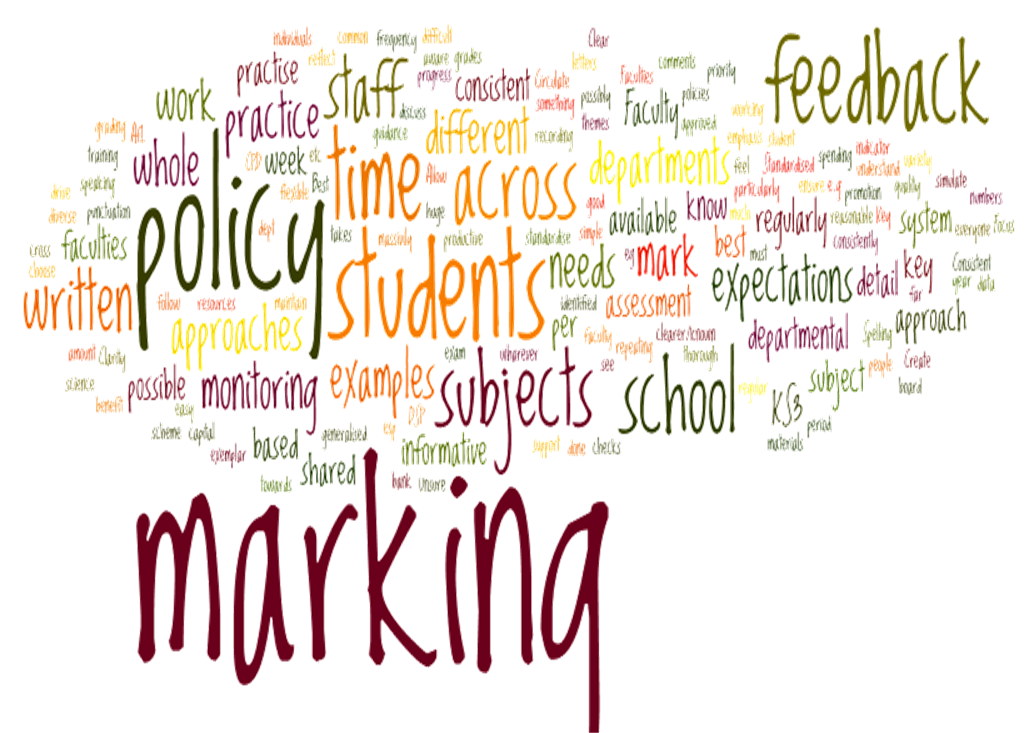
    wordle from https://educatingmatters.wordpress.com/effective-marking-2/ 
  3. Be more organised - folders all ready and prepared with all the resources needed for those schemes of work prepared during the holiday.  Next year I have a pupil with quite complex needs in my class.  In order to provide the best scaffolding for her to develop more independence in her work, the TAs need to be able to adapt the resources or scan them into her computer ahead of time.  This will be much smoother for everybody if they are there and easily accessible.  Also plan ahead for things like assemblies, Christmas craft projects, report writing and parents evening as much as possible.  You know these things are going to crop up, so being prepared for them will save a weekend of panic before each one.
  4. Marking during the working week - Marking is probably your most time-consuming daily activity (apart from teaching!).  Assume that four pieces of work per child require marking every day.  Even a cursory glance and a quick comment will probably take at least one minute per book - that's a minimum of half an hour for a class set of books, multiplied by four.  In reality, when you're marking English books and the children have written a page of text, which you have to read, highlight and comment on errors, and provide positive constructive feedback and next steps, each book will take at least five minutes - a total of 2.5 hours for the set!  I can very easily do four or more hours marking from one teaching day, and I know I'm not alone.  So, plan more thoughtfully to reduce marking load.  Plan more time in to lessons for children to self-assess and peer-assess, and teach them the skills to do this; or plan for you to go through and mark the work with the children.  This isn't a cop-out for the teacher, and it won't lessen the expectations on the children.  According to the Education Endowment Foundation, little research has actually taken place into the effectiveness of written marking, which is bizarre considering that schools place such emphasis on it, and teachers spend so much time on it, but it seems that the most effective marking gives early, specific feedback to the children, with clear targets for next steps, and the opportunity to respond, either extending understanding or clarifying misunderstanding.  If this can be done effectively with the children, then it is worth looking into, and could take hours off your evening.
  5. Labels - If you find yourself writing the same comment over and over again on your marking, or you have several children who you know will require the same constructive feedback / next step, then consider using printed sticky labels.  I will definitely have some labels marked: please underline, DUMTUMS for date and Next Step please, remember to join your handwriting for those basic presentation issues which our OfSted consultant has suggested we need to pick up in our marking as part of having "high expectations".
  6. Image result for teacher marking
    image from www.teachertoolkit.co.uk  
  7. Use technology - We have i-pads in the classroom, and I don't use them enough.  There's a useful platform called Google Classrooms - it will take time to set it up for the class and train them to use it, but in the end this will pay dividends.  Rather than printing off and trimming worksheets, I can set them as an 'Assignment' in the app, and they can just read off the i-pad.  If they are working with practical activities, I can set this as an assignment, and they can photograph it with the i-pad and it will upload into a folder in the app.  I can even comment on it (providing feedback) there and then in the app.  To provide evidence for their exercise books, they write the date and objective, and I print them a sticky label with a brief explanation and a QR code linking to the folder.
I look forward to trying out my own advice, and will get back to you with feedback next term on how its going and whether I am restoring some of my work-life balance (if I am you'll probably see more posts on here, and a bit more craft going on!)  I think the basic rules that I'm applying are: less written work for me and the children but higher quality and more effective.  Fewer hours working for me.

Tuesday, 24 May 2016

6 steps to prepare for a teaching job interview

Competition in the teaching job market seems to be as fierce as ever, with sometimes many tens of applicants chasing one vacancy, particularly the prized permanent positions which offer so much more security and scope for career progression.  If you've made it as far as the short-list then your application form must be pretty good, so the next hurdle is the interview.  How to demonstrate to this school that you are the best person to fill their vacancy.

Confessions of a Teacher: Teacher Interview questions and answers:
  1. Find out about the school - you'll most likely already have done a lot of homework about the school, including a visit and tour before you completed your application form.  Now is the time to consolidate that research.  Revisit the school website; read key policies; read any school newsletters; have a look at the most recent OfSted Inspection Report.  Being able to comment at interview on something that the school does and how you can contribute or add to it will help the panel to see you as the missing piece of their school jigsaw.
  2. Plan your answers - When I've had feedback from unsuccessful interviews, particularly where the headteacher knows me, I've been told that I don't say enough at interview.  Even though the headteacher knows that I do something or know about something, when the opportunity to say so comes up in the interview, I miss it.  I've now made myself a set of Key Interview Answer index cards.  Each card has a potential topic on, and a brief note of the key items I must get across when I answer a question on that topic.  So I have cards on Safeguarding, Outstanding Lessons, the Curriculum, Behaviour Management, and Assessment.  I've also made a note of specific examples from my own practice that I can talk about in each area.  Before the interview I am looking at these cards daily, and I'll take them with me to look at as a refresher just before the interview.  Hopefully when the questions come up I'll remember to cram in every point and not miss the chance to show what I know and can do.
  3. Update your knowledge - Make sure that you are up to date with changes to the curriculum or assessment.  If there have been changes then they will almost certainly ask about what you think about them in your interview.
  4. Prepare your lesson - Almost all teaching interviews now include an observed lesson to give the panel the opportunity to see how you really interact with children, and how you operate in the classroom.  This is another area I've had feedback on from unsuccessful interviews.  Each time I've been told that while I clearly know my stuff and have a great rapport with the children, my lessons are too complex and busy.  So the first rule here is to Keep It Simple.  Have a very clear idea of what you want the children to learn from the lesson, and work on how you are going to achieve that.  If possible, get in touch with the Class Teacher beforehand to find out what topic or area of work the class are currently covering so that you can fit in with or refer to it.  The teacher should also be able to give you information on class groupings and abilities and whether there will be a Teaching Assistant in the room, so that you can plan accordingly.  The panel don't want to see the top of 30 heads working in their books, they want to see you interacting and teaching, so the more interaction in the lesson the better.  Don't be scared to use practical activities and games - yes, the children will get excited and the noise level may rise, but as long as you are on top of this and the children are engaged then some good learning will be happening.  Be wary of relying on technology - finding out that the interactive whiteboard is different from the one you are used to, or that the computer won't read your memory stick minutes before your lesson just adds an extra layer of stress that you don't need.  There's plenty of time in the interview to talk about how you use technology in the classroom, for your observed lesson aim to do without (unless its a Computing lesson!).
  5. Practice - Practice answering possible interview questions (back to those index cards), and if possible practice your observed lesson.  While every class will respond differently to any lesson, by running through it you'll at least have a clear idea of potential pitfalls, time-scales and the resources that you need, as well as feeling more confident when it comes to actually delivering the lesson.
  6. Plan your day - we're now on the logistics side of the interview.  What time do you need to arrive?  How will you get there and how long will it take?  Where will you park?  Do you need to take a packed lunch?  What time will you expect to finish?  What will you wear?  What will you do afterwards?  (Usually the Headteacher or Chair of Governors will phone later the same day to let you know the outcome of the interview, so you can either be driving home, pacing nervously up and down your sitting room, taking your kids to their swimming lesson and sitting in a noisy swimming pool, relaxing with a book in your favourite cafe, or out for a nice walk with the dog - whatever you will be doing, make sure that you can hear your phone and will be available to take that call.
Good Luck!

I've written this post because I'm in the middle of making all these preparations.  I have a job interview on Thursday for a part-time post starting in September teaching Key Stage Two.  I had applied for a couple of permanent and full-time posts, for which I wasn't short-listed (boo).  But with all the issues with my health at the moment (which seem to be getting more rather than less complex), I think part-time or even Supply Teaching is probably the best option for me for the moment.  I'll let you know how I get on.


Saturday, 19 December 2015

We've made it to the holidays!

Woohoo!  It's the holidays.  

After my first term back to work as a teacher I am remembering the feeling of relief when you wake up in the morning realising that you've made it.  A lot of people look at teaching and think it's an easy option - you get so much more holiday than everybody else and the kids are only at school from 9-3.30 right?  It's true.  We are pretty lucky.  What the public don't necessarily see though are the hours of preparation, marking, assessment, record keeping, report writing and creating resources which means that many teachers work well into their evenings, weekends and holidays.  Or that when the kids are at school you are never really "on a break" as you're preparing for the next lesson, running clubs, on playground duty or interrupted by a knock on the staffroom door - and that interacting non-stop all day with thirty seven-year-olds can be pretty intensive.  I'm not looking for any sympathy here, it's probably the most rewarding and wonderful job there is, I'm just explaining why teachers start exulting, cheering and whooping, before dropping onto their sofas for a sleep, when the end of term arrives.

It's also pretty exhausting for the children.  Bug has just reached the end of her first term at school too.  Aged four, she has found the last couple of weeks stretched her a little thin.  Christmas fair, school play, school disco, swimming lessons, Mummy's school play, with the addition of Breakfast Club and After School Clubs to fit in with my work has meant that she's been asleep almost before her head's hit the pillow this week and is now full of cold.

So waking up this morning and knowing that it's the holidays has felt pretty good for all of us.  Even Hubby gets to join in, as he also now has a week off work - so we're all in "beginning of holiday" mode together.  Today's tasks involve Christmas cards, wrapping gifts, last minute gift shopping, housework, haircuts and bathing the dog - all of which can be done with no real urgency.  Thank goodness!

I've also reached a milestone.  I was pretty disappointed not to get the permanent teaching jobs I applied for at the school where I've been teaching this term (on a one-term contract).  I know they liked me and my teaching, but my job application and interview did not do me justice.  The headteacher gave me a lot of really good feedback, and was able to give me some great advice and support writing my next job applications - so I did get a job from that one.  I'm starting at a new school in January, this time teaching Reception Class for two terms.  It's going to be interesting as I will be team teaching for the first few weeks, before the current teacher goes on maternity leave.  I'm also intrigued by the classroom set up, as the school has rapidly grown, and their building expansion hasn't yet kept pace, so there will be two classes (with all the Teachers and Teaching Assistants) in one classroom until the new room is built.  Watch this space for an update!

Tuesday, 29 September 2015

The teaching of Handwriting

I'm currently teaching handwriting to two different classes, Year 3/4 and Year 5/6.  Not quite satisfied that I was doing this in the best way I did a little research and came up with the post that follows.  I'm now planning my handwriting lessons for the rest of term, and am much more confident that the children will actually be improving their handwriting.

The Teaching of Handwriting – A progressive approach
The purpose of teaching handwriting is to enable children to communicate effectively in writing.  Their writing will be legible (easy to read), fluent (they can write reasonably quickly with a good flow) and comfortably (children who have not learned to handwrite properly or who employ poor posture often find writing painful as they become quite stiff).
The teaching of handwriting is often provided as a whole class activity, with children assiduously copying letters, joins or words from the board and repeating.  It is true that handwriting can only be achieved by regular practice.  It is also true, however, that children enter school with differing handwriting readiness.  Their motor skills both gross and fine are at different stages, and therefore their readiness to pick up a pencil and begin making marks and then letters will all be at different stages.  It is as important with handwriting as it is with reading that we take each child from their own starting point and provide the relevant practice to enable them to achieve success and to progress at their own pace.  Here then is a progression chart for handwriting (the first two stages are concurrent).  In your class, whatever the age group, assess the handwriting skills level of each child, group those on a similar level together for handwriting work, and provide the relevant activities to enable them to progress to the next level.  While in some classes the children may all be at a similar level, in others it will become clear that there are children attempting to join their handwriting who have still not mastered letter formation, or who are not yet forming their letters in a uniform size.  In younger classes you may have some children who still do not have the physical readiness for writing, and who are not yet ready for letter formation, certainly not trying to write on lined paper.  In handwriting lessons, while the copying and practice is very important, it is equally important for the Teacher or a Teaching Assistant to give direction and feedback on letter formation, sitting position, evenness of script, achieving smooth flow, and pencil grip.
Contrary to popular opinion, the advent of the tablet, the smart phone and the computer has not replaced the need for fluent, neat handwriting and this life skill needs to be taught with care and attention.  Children leaving primary school must be able to write without thinking about it, so that they can concentrate on the content of their writing.  Research also demonstrates that children with neat handwriting tend to feel better about their writing and are more motivated to write, and are also better at spelling.  Every child should be supported to develop good handwriting.


Stage
Activities to support progress
Developing core strength and stability, bilateral co-ordination, sensory perception, hand and finger dexterity – core strength and stability are required to develop posture and coordination; bilateral co-ordination allows the child to cross the body successfully; sensory perception allows the brain and fingers to communicate effectively about textures and pressures; hand and finger dexterity involves the ability to hold and manipulate objects of different sizes.
Curl-ups, balance along a ‘tight-rope’ line along the ground, walking up and down stairs.  ‘Simon says’ using left and right, rolling and catching and then gently throwing and catching a ball, touching left toes with right hand etc. Feely bag, tactile play, being able to press gently or hard into balls of playdough.  Picking up and holding small objects, two or three objects at a time.  Finger dancing.  Rolling and releasing dice.  Cutting things up with scissors, moving on to accurately cutting out shapes.
Mark Making (these two stages run concurrently as children will be beginning to make marks while still developing their physical readiness).
Provide tools in a wide range of thicknesses as the child is developing their dexterity, they will be able to choose thick or thin brushes, crayons and pencils.  Provide sand trays to trace in, large sheets of paper and paper with widely spaced lines or squares.  Provide vertical or sloped writing surfaces as well as horizontal.  Trace large scale shapes and patterns.
Pre-handwriting patterns.  These establish the correct pull and push movements for all the shapes which make up the letters.
Teach correct pencil grip (sometime between age 4 and 6), and establish a good table height and sitting position for writing.  Trace over shapes and patterns.  These can start at quite large scale and then gradually become smaller and finer.  Patterns will include waves, circles, vertical and horizontal lines and circles. 
Letter formation – letters should be taught in groups based on the shape, rather than in alphabetical order.  Once the letter shape and how to form it has been established the children move through these stages as their fine motor skills develop.
Tracing over and forming letters with plasticine or playdough, in sand or salt trays, with whipped cream, on large pieces of plain paper.  Lower case letters (plus capital for their name), then numbers, then upper case letters.
Tracing over and copying letters on widely spaced lines.
Tracing over and copying letters on narrower lines.
Letter joins – a child is ready to start joining their writing when they are consistently forming their letters correctly, positioning them correctly on the line and maintaining a uniform size
Teach and practice each of the four main join types one at a time.  Diagonal join e.g. a-i, a-r, u-n, i-r, i-g, m-a, a-d; upper horizontal join, e.g. o-u, o-v, v-i, w-i, w-o, o-n, o-x; lower join to tall letter, e.g. a-b, u-l, i-t, t-h, b-l, l-l, l-k, e-b; higher join to tall letter, e.g. o-l, r-t, o-b, r-k, w-l; special joins f-f, f-t.  Break letters z (before) and g, j, q, y, and x (after)
Join whole words together.  It can be helpful here for the children to practice handwriting with their spelling words, developing two skills in one.
Developing fluency and style – Children can be encouraged to slope their handwriting slightly and to develop their own handwriting style.
Copying poems or making neater copies of their work for presentation.
Some key points in handwriting:
·         Pencils must be sharp
·         Short pencils (below 8cm) should be discarded.
·         Sit up properly with chair upright (not rocking).
·         Writing surface can be tilted to the left (right handers) or right (left handers) but by no more than 45 degrees.  The non-dominant hand should be on the table in a supportive position.
·         A clutter free table is best.
·         Left handed children should always sit on the left side of the desk

Children can be taught to be self-critical and even pedantic with their handwriting.  When working with a group, expect them to copy EXACTLY, and nothing less, as this will avoid any poor habits being deemed as acceptable.  As long as the work is pitched correctly for their ability and motor control then they will be able to succeed and will look with pride on their improved writing.

Tuesday, 9 June 2015

Developing Children's Creative Writing


What is Creative Writing?

Creative writing is difficult to define.  It is the art of making things up; illuminating truths about the world and the people in it in an interesting and attractive way.  Creative writing is original and self- expressive.  Genres of creative writing include poetry, movie or play scripts, song lyrics and novels.


Why is Creative Writing important?

Creative writing develops thinking in children which extends far beyond their writing.  Being able to think creatively means being able to think outside the box and use imagination, which is essential for all types of problem solving.  

Creative writing is also a useful outlet for self-expression – sometimes it’s hard to work your way through a problem, express your feelings, or work out your own morals, but writing it down as a problem for a character to face, or in poetry or song lyrics helps to work it through and get it out.  

Thinking about characters, their motivations and feelings helps to develop empathy.  

Being able to express yourself clearly will lead to a lifetime of clear communication.


How to develop Creative Writing in children.

Most of these activities are for Primary School children, and can be done in class or workshop situations, but there’s nothing to stop them from being adapted and used at home or with younger or older children or even adults.
  • ·       The most important thing to do to develop creativity is to get lots of experience.  It’s difficult to write about a beach on a far-off planet, or a treasure island, if you’ve never been to the seaside or seen the ocean.  It’s difficult to write convincingly about something happening at a football match if you’ve never been to one.  While extensive reading, and watching television and films, can begin to bridge this gap, it’s no substitute for real first-hand experience.  While it’s true that if you lead a cloistered life, you can still write beautiful creative fiction or poetry simply by sticking to what you do know, or by creating something entirely from the realm of fantasy, wide experience gives you a lot more to draw from.
  • ·         Role play helps children to think through how characters might react to different situations, and how dialogue works.  Extended role play helps them to think about what makes a good story – a role play game of mums and dads where they get up, go to work and make dinner is all well and good for a while, but children soon work out that things get a lot more interesting if there is conflict or a problem to solve.
  • ·         Encourage children to describe using all of their senses.  A walk in the woods – what can you hear?  What do you see?  What colours are all around you?  What do you smell?  What does the air taste of?  What do the tree trunks feel like?  What does this peach smell like, taste like, feel like, look like and sound like?
  • ·         Pick any object or phenomenon and come up with as many similes and metaphors as you can.  For example, “this daffodil… is like a patch of summer… is like a beam of sun… is like a smiling face… is a fresh faced child on a spring morning…”  “The wind… is like a toddler tantrum, fierce and loud… is like a rollercoaster ride… is like a bully in the playground…”
  • ·         Start creative journaling.  Regularly open the journal to a new page and write something.  It might be a description of the view outside, a story opening, a descriptive passage about an imaginary character, or a poem.  Anything you like, as long as it’s unique and expressive.
  • ·         Create a character together.  Pick a name at random from the phone book.  How old do you think this person might be?  What’s their ethnic background?  What’s their family situation?  What kind of person are they? What do they look like?
  • ·         Take the previous suggestion to the next level.  Either using a character from a known story, or an invented character – start to think about how they would behave in different situations.  Is their bedroom tidy?  How would they behave at a football match?  Would they make a good friend?  If you lived next door, what would their garden be like?  Would they feed your fish while you were away?
  • ·         Once they can describe a person, an object or a situation using all their senses and some wonderful descriptive adjectives and similes, it’s time to introduce them to ”show, don’t tell”.  Think about their character eating a peach.  We could tell: “He ate a juicy peach”, or we could show: “He bit into the peach, and hurriedly wiped away the sticky juice that dribbled down his chin” which also gives information about the character and how he might be feeling.
  • ·         When you’re reading stories and poems together, stop and think about what description the author or poet has used.  How do they describe the character?  How have they begun the story?  How have they brought it to an end?  Is their dialogue long and descriptive or short and punchy?  How do we know how the character is feeling in this situation?


There is so much to include in this topic, that we’ve only really covered description of place and character, and haven’t even got started on plot development or poem structure, which is going to have to form the basis of a future blog post.  Children are innately creative and imaginative, so developing creative writing is simply about harnessing that, getting them to use what they see around them, and find the words to put it on paper as written art.